The Institute of Applied CX Science
Customer experience, audited like a balance sheet.
Every broken customer journey costs money: repeat contacts, rework, escalations, credits and the customers who leave. The cost sits in five different ledgers, so nobody adds it up. IACS-7 is the Institute's published method for adding it up, in figures your finance team can check line by line. The Institute applies it with organizations as a consultancy and teaches it in certificate programs, in English and Arabic.
One billing journey, one year
- Repeat contacts240,000 journeys × 23% fail × 1.2 extra contacts × $7$463,680
- Manual rework240,000 × 10% reworked × $18$432,000
- Escalations240,000 × 4.5% escalated × $38$410,400
- Goodwill and credits240,000 × 6% credited × $22$316,800
- Cash costthe four lines above$1,622,880
- Attributable churn1,000 extra leavers against a comparison group × $210 margin × 1.5 years$315,000
- Annual friction costcash cost plus the churn estimate, each shown separately$1,937,880
Low case to quote first (cash only, less a 30% allowance): $1,136,016
The problem
A satisfaction score can rise while the customer book loses money.
The Institute calls this the Solvency Paradox. It is not an accounting error. It is a gap in what gets measured.
Revenue is audited. Customers are not.
The income statement is audited every year. The customer book that produces it is described by satisfaction and loyalty scores that are computed in different ways and rarely reconciled to the ledger.
Goodwill buys the score.
Credits, repeat contacts and human rework keep customers happy with systems that keep breaking. The cost of buying that happiness never appears on a customer experience dashboard.
Some revenue costs more than it earns.
A customer who calls six times a month and rates the service highly can cost more to serve than they pay. Ranked by revenue, that customer looks valuable. Ranked by what they are worth, they are not.
Repeat contacts, rework, escalations, credits and attributable churn, joined for one journey.
Burden, APR, tier, C‑BEP and alert state, for every customer.
Margin against friction, a picture a management team can argue with.
The Financial Control Grid
Rank customers by what they are worth, not by what they pay.
Put margin and friction on the same row and four kinds of customer appear. The grid shows where to look. The five numbers of the Standard decide what to do.
Accounts A to D are a constructed teaching set, split at the median of this four-account book. Choose a quadrant to read its strategy.
Silent Killers
Low margin, high friction Strategy: ExitWhere to start
Five ways in, from ten free minutes to a full audit
The worksheet prices one journey. The audit prices one business unit. The Academy teaches your people to do both.
Founding Cohort, 2026
Five organizations. One business unit each. No fee.
The Founding Cohort receives a full 21-day Friction Audit built from its own data: the avoidable cost of one business unit's broken journeys, how much of it is recoverable and in what order, presented to leadership with a written report. In return we ask for anonymized data and one case study you approve before it is published.
Status
What exists today, and what does not yet
A method that asks finance to trust its numbers should be plain about its own. This list is kept current.
The IACS-7 Standard
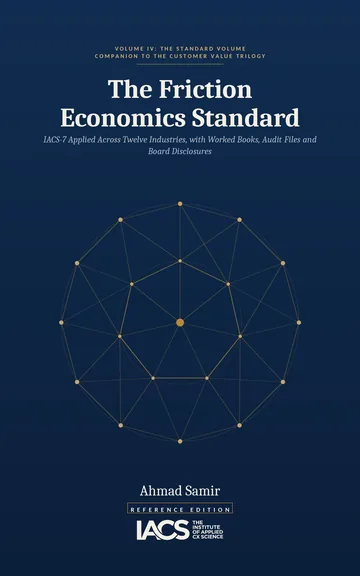
Published in full in The Friction Economics Standard (Volume IV), on Amazon.
PublishedReplication archive
Replication files for The Friction Economics Standard are public on Zenodo.
PublicAcademic papers
Two papers on the method are in preparation, one with a university co-author.
In preparationPeer review
The method has not yet been peer reviewed or tested on observed client data.
Not yetCredentials
No IACS credential has been issued. The first certification cohort is planned for January 2027.
Not yetConformance opinions
The Standard defines how conformance would be assessed. No opinion has been issued and no firm is accredited to issue one.
None issuedOutside recognition
The Institute is a private body. It is not accredited by, or affiliated with, ISO or any national standards or accreditation body.
Not claimedClient data
Client data is never published without the client's written approval of the final text. Every worked example is constructed and says so.
PolicyThe books
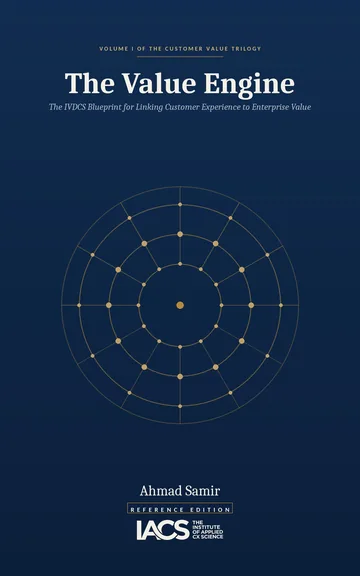
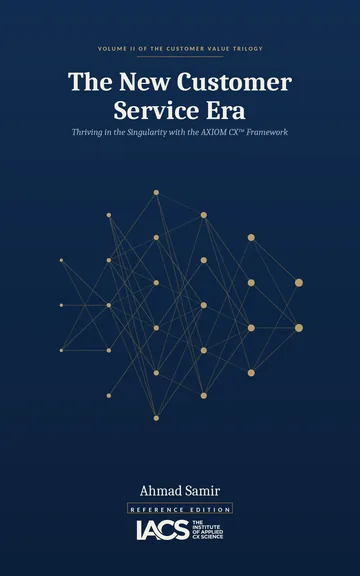
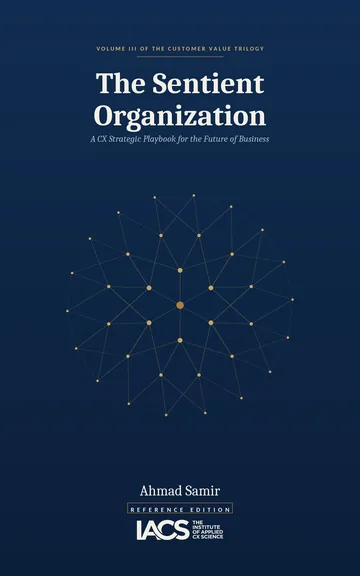
One argument in three volumes, and the standard behind them
From the price of a customer relationship to the board paper that discloses it.
Newsletter and papers
Friction Economics, on Sundays
New pieces on the Institute's LinkedIn page, and four white papers by email as they are released.